
Sources Behind Brighton's Previous Residents
One address needs a time ladder. Begin with the modern parcel, then move through deeds, plats, directories, census, newspapers, permits, voter records, and probate or obituary clues. Each source has a different date and a different relationship to occupancy. The table marks the known local coverage without turning a gap into a claim.
| Source | Years Located | Where Held | What It Shows |
|---|---|---|---|
| Adams deed and grantor-grantee books | 1902 forward in books; online 1915-current is a 2019 budget clue | Clerk & Recorder and Landmark | Recorded parties, instruments, legal descriptions |
| Historic plats | 1905-1941 | Colorado State Archives finding aid | Lot, block, subdivision, and old address bridges |
| XL New Denver Suburban Directory | Publisher from 1927; Brighton editions noted 1957 and 1961 | FamilySearch catalog and library lead | Alphabetical and street-guide household clues |
| Brighton Blade | 1902-current metadata; 1980-forward weekly representation | LOC, microfilm, Anythink databases | Obituaries, announcements, moves, civic ties |
| Federal census | 1850-1950 public; 1950 latest released | NARA, FamilySearch, library | Point-in-time household and address context |
| City permits | 2026 examples; older depth not stated | Brighton Reports and records route | Construction, valuation, address, project dates |
A previous-residents search is strongest when each row has a source date, event date, and confidence note. “Last seen” is not the same as “last lived there.”
Start With Today's Brighton Parcel
Open Adams PropertySearch or the county Basic Web Map with the street address. Save the parcel number, subdivision, lot and block when shown, situs address, owner name, mailing address, city or county, and the date inspected. If the parcel falls in the northern Weld portion of Brighton, use the Weld property route linked from the Brighton GIS page. A city label, ZIP, and county are not interchangeable.
The parcel is the bridge between current data and the old deed. `CONCATADDR1` and `CONCATADDR2` describe the parcel address. `OWNERADDRESS` and `OWNERCSZ` describe the owner mailing record. A mailing address can be a post-office box, agent, business, or another parcel. It can support an identity clue, but it cannot prove that a person occupied the house.
Keep a worksheet with the fields below before opening a historical index.
- Parcel number
- The assessor and GIS identifier for the mapped land unit.
- Situs address
- The physical address associated with the parcel, which may differ from an old deed label.
- Legal description
- Lot, block, subdivision, quarter-section, or metes-and-bounds wording that can survive an address change.
- Chain of title
- The ordered sequence of recorded transfers, not a guaranteed record of continuous occupants.
Walk Back Through an Adams Deed Chain
Landmark Web is a party-name index. Search the current owner as a grantee around the acquisition date, open the matching instrument, and compare the legal description with the parcel. Then search the seller as an earlier grantee. Continue backward only when date, parties, and legal description line up. A name alone is not enough because the same person can appear in more than one Brighton parcel or in a document unrelated to the house.
- Normalize the address, including directional words, street type, and ordinal forms such as 1ST and FIRST.
- Confirm Adams or Weld, parcel number, subdivision, lot or block, and the current owner from GIS or PropertySearch.
- Search the current owner as grantee in Landmark with an approximate recording date.
- Save grantor, grantee, document type, recording date, reception or instrument number, book or page, legal description, and image path.
- Search the grantor as an earlier grantee, constrain by the same legal description, and repeat until the index or physical books end.
- Pair each recorded link with a directory, census, newspaper, permit, or probate clue before listing someone among previous residents.
The Adams Recording Division says online uncertified copies can be viewed, printed, or downloaded without a watermark or login. Certified copies use the office or phone route at 720-523-6020. A recording fee paid to submit a document is not the same as the access cost for an online copy.
The Adams Landmark recorded-document search shows the live source for the deed-index route.
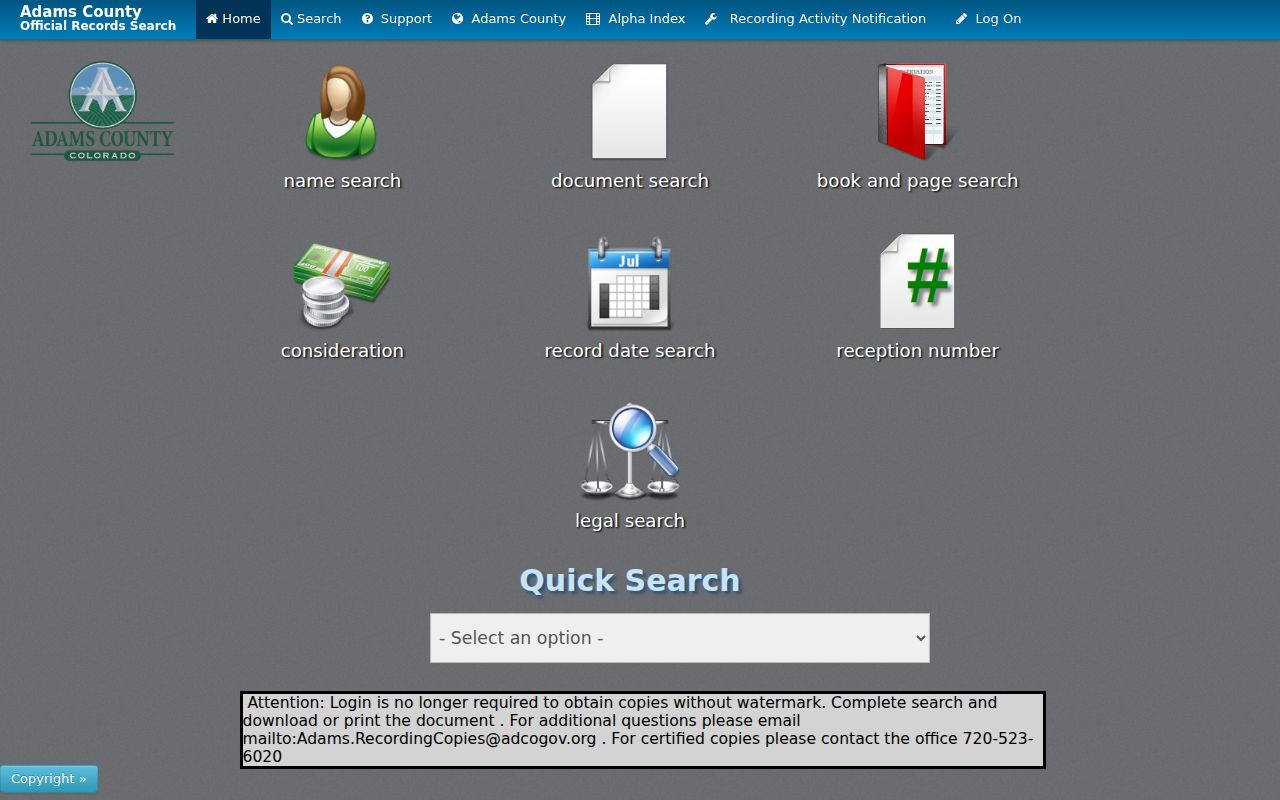
The Landmark image links to the county portal and shows the name, document, book and page, consideration, and date search paths used to choose a deed record.
1902 Books and the 1915 Online Clue
Adams County was created in 1902, and the Clerk & Recorder's historical books reach back to that county start. The current Landmark pages do not state a firm earliest online index or image year. A 2019 official county budget described internet indexes and images as 1915-current. Treat 1915 as a documented historical online-coverage clue, not as a guaranteed live boundary.
For previous residents before the online trail, try the Historic Alpha Index and ask the Recording Division about book scans or counter access. The Alpha Index exposes Book Indexes, Scan Only, Criteria, Final Verified, and page controls. The county's restoration story is a useful local numbers clue: the first 2018-19 phase restored 83 books, while more than 1,200 books needed treatment. A faint or absent scan can reflect preservation and custody rather than a missing person.
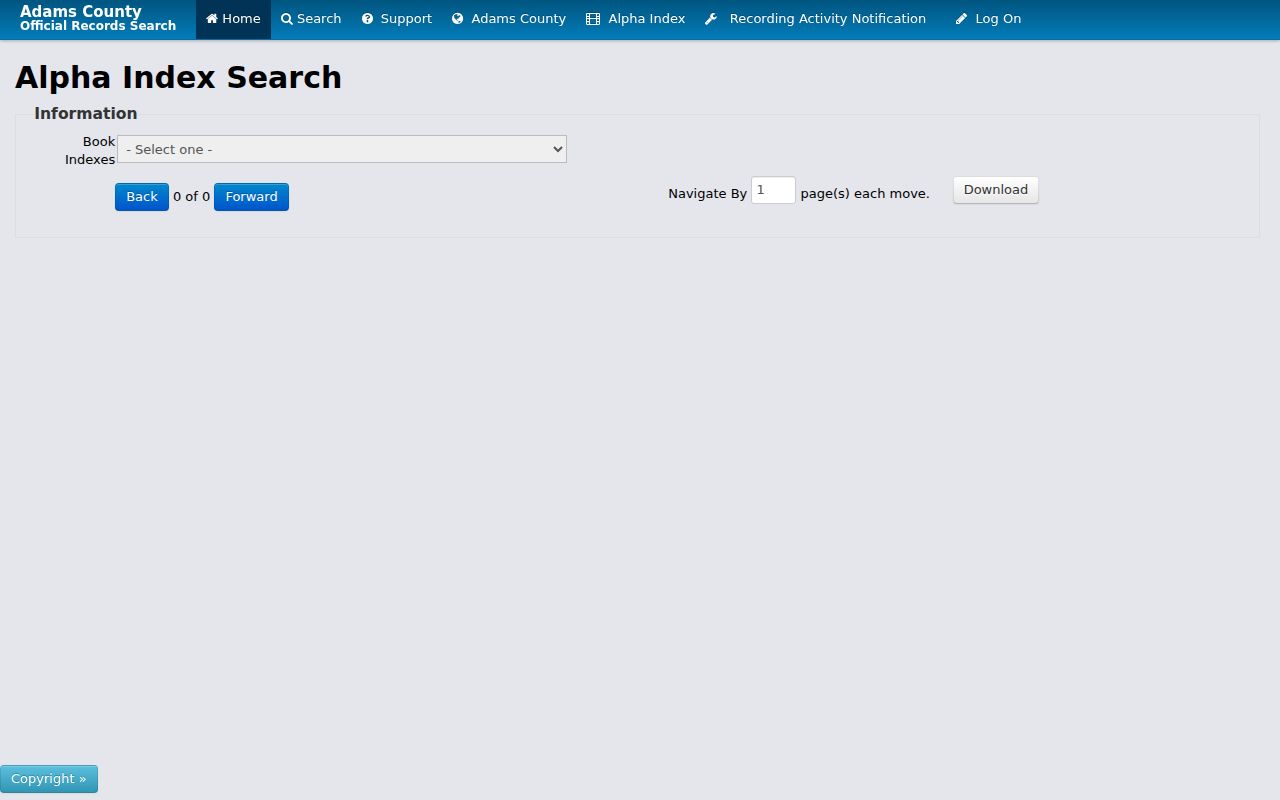
The Alpha Index screenshot connects an early previous-residents search to a historic book path. Record the book set and page when a result is found, then compare its legal description with a later parcel.
Plats Bridge Old Brighton Addresses
Old deeds may omit a modern street number or use lot and block language instead. The State Archives finding aid lists Adams plats from 1905-1941. A plat can connect a subdivision, lot, block, and street to the current parcel. Brighton's preservation material also shows address normalization such as “5 S 1ST AVE” and “5 S FIRST AVE.” No official citywide renumbering or renaming year was located, so the spelling example is a search clue, not a dated conversion.
Search the historic legal description, not only the street string. Compare neighboring lot numbers, subdivision name, and street direction. If the legal description changes between deeds, note the change rather than forcing a clean match. A previous-residents timeline should show where the bridge is certain and where a plat or custodian review is still needed.
Directory and Census Eras Around Deeds
Directories fill the household layer between deed events. The FamilySearch catalog identifies XL's New Denver Suburban Directory, with publication beginning in 1927 and Brighton-inclusive editions noted for 1957 and 1961. Start with the street guide when an address is known, then compare the alphabetical entry. The full Brighton year run is not published in the catalog, so label a volume as a cataloged edition rather than a complete series.
Pair a directory year with the 1950 Census. Census fields can separate same-name people through street address, household relationship, age, birthplace, and recorded occupation. A directory can be compiled before its cover date, and a census captures one point in time. The Brighton Blade adds announcements, obituaries, organization notices, and move clues. Use those clues to choose the next deed, probate, or vital-record request.
The historical collection itself is explained in the Brighton city directory page; the previous-residents task is to place one address inside that collection rather than repeat every shelf detail.
Permits Date the Building, Not the Household
Brighton Reports can supply permit number, type, issue date, valuation, location, and subdivision fields. Certificates of occupancy and major alterations can explain a physical change between two deed or directory entries. Eye on Adams may add building permits, code violations, and land-use cases in unincorporated areas. City and county coverage differ, so keep the jurisdiction beside the result.
A permit is an activity record. The applicant, contractor, owner, and occupant can be different people. Do not use a permit date as a move-in date. Instead, place it on the timeline and ask whether a directory, census, newspaper announcement, or deed supports the same transition.
Brighton House History Has a Library Gap
Anythink Brighton provides public computers, research help, and access to Brighton Standard Blade databases at 327 E. Bridge Street. Published hours are Monday through Thursday 9-8, Friday and Saturday 9-5, and Sunday closed. Remodeling temporarily affected meeting rooms and programming, so check before visiting. The public branch page does not state exact print directory years, reverse-directory shelves, obituary index, funeral-home files, or a house-history service.
Ask reference staff to check for XL editions, street guides, phone books, Blade microfilm, yearbooks, cemetery material, and a house-history guide. The Adams County Museum at 9601 Henderson Road is another local-history route. Its mission covers Adams County and South Platte cultural and natural history, but no detailed online finding aid or house-history fee schedule was located. These gaps are named research questions, not permission to invent a collection.
Obituary and Probate Trail Endpoints
A Brighton Blade obituary can close one part of a previous residents trail by giving a death date, relationship, address clue, or executor name. Probate filings may identify an executor, heirs, attorney, or property. Search only material that is public and relevant, then compare the date and legal description to the recorder sequence. A newspaper notice is a lead, not a certified death record, and a probate file may be sealed or redacted.
Colorado vital records are confidential under C.R.S. 25-2-117. Certified copies require direct and tangible interest, identity, and eligibility proof. If a death record is not available through a public route, use the CDPHE or county custodian rather than treating the obituary as an equivalent. The endpoint of a house history is often a set of corroborating sources, not a single perfect occupant list.
Past Households Need Careful Language
Previous residents can mean a recorded owner, a directory occupant, a census household, a voter, a newspaper subject, or an inferred occupant. Those roles should not be merged. A deed chain is about title sequence. A directory is about a publisher's household entry. A census is a point-in-time enumeration. A voter list is a registration product. A newspaper is an announcement source. State each role beside the name and date in the research worksheet.
Use the backward trail for family history, preservation, genealogy, or a question about a building's past. Do not republish sensitive details from living people or try to work around a protected address. A gap can be meaningful: a protected voter, confidential vital record, or missing directory scan may reflect a lawful access limit.
Lawful use. Brighton previous residents records support personal and historical research. A past address is not an invitation to contact or follow a living person, and public sources must never be used to stalk, harass, or harm anyone.